

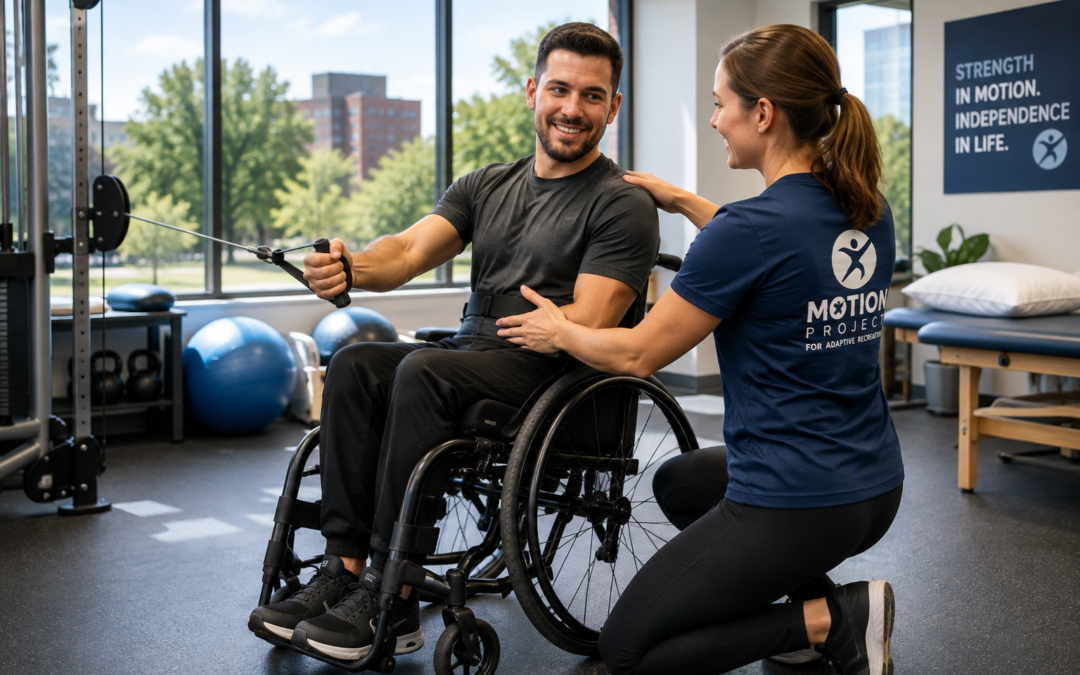
For many Amherst, NY families, one of the hardest moments in the recovery process isn’t the injury itself — it’s the day insurance-covered therapy ends. Progress may still be happening. Goals are still on the whiteboard. But the sessions stop, and the question becomes: what now?
Activity-based therapy is one answer many individuals living with spinal cord injuries and paralysis explore at that point — and at every other stage of recovery, whether an injury happened last year or fifteen years ago. This article explains what activity-based therapy is, what one-on-one recovery sessions can look like, and how individuals from Amherst and across Western New York can learn more.
What Is Activity-Based Therapy?
Activity-based therapy is an approach to rehabilitation built on repeated, guided physical activity — often designed to engage muscles, nerves, and movement patterns both above and below the level of injury.
Rather than focusing only on adapting to an injury, activity-based approaches give participants structured opportunities to keep working their bodies toward personal goals. Depending on the individual and their program, that work may include:
- Repetitive, task-focused movement training
- Strength and conditioning
- Weight-bearing activity
- Standing and body-weight-supported movement
- Core strengthening and balance training
- Range-of-motion and flexibility work
- Functional electrical stimulation, which uses gentle electrical pulses to help activate targeted muscles
An important note on expectations: activity-based therapy is not a cure for paralysis, and no program can promise a specific result. Outcomes vary widely from person to person, and progress may look different for every participant. What activity-based rehabilitation offers is the opportunity — structured, consistent, and personalized — to work toward goals that matter to you.
What One-on-One Recovery Sessions Can Look Like
One of the most valuable parts of activity-based rehabilitation is individual attention. Here’s how one-on-one recovery sessions are generally structured.
Starting with an individual assessment
Everything begins with an assessment. Before any program starts, a professional evaluation helps identify a participant’s current abilities, needs, health considerations, and goals. This step matters because no two spinal cord injuries are alike — an approach that fits one person may not fit another. Participants should also coordinate with their own healthcare team when beginning a new program.
Personal goals drive the plan
Recovery goals are personal, and they’re not all about walking. Common goals include:
- Building strength and endurance
- Improving transfers, such as moving between a wheelchair and a bed or vehicle
- Improving balance and core stability
- Maintaining range of motion and flexibility
- Supporting circulation and overall health
- Building confidence and independence in daily activities
- Returning to meaningful activities — work, hobbies, family life
In a one-on-one setting, each session is shaped around those individual goals. Progress is tracked over time, and goals can evolve as participants do. Every kind of progress counts, whether it’s a stronger transfer, better endurance, or simply feeling healthier week to week.
Specialized rehabilitation equipment
Activity-based programs often use specialized rehabilitation technology that can be difficult to access elsewhere. Motion Project Foundation’s associated recovery center in Buffalo has featured equipment and technologies such as the Lokomat, ZeroG, and ArmeoSpring, which support activities like guided gait training, body-weight-supported movement, and upper-extremity training.
Equipment suitability always depends on an individual assessment — not every technology fits every participant — and availability should be confirmed when you inquire. The purpose of this technology is straightforward: to make high-repetition, guided movement possible and productive.
Recovery Beyond Insurance Limits for Amherst, NY Residents
Traditional insurance coverage often supports rehabilitation for a limited time after an injury. For many people, that window closes long before their personal goals do.
This is where Motion Project Foundation’s mission comes in. As a Western New York nonprofit, the foundation works to expand access to recovery opportunities beyond traditional limitations. That includes:
- Activity-based rehabilitation opportunities through its associated recovery center
- Grant and financial-assistance opportunities that may help reduce cost barriers for eligible individuals
- The Hope in Motion Scholarship, created with support from the Scott Bieler Family Foundation, which is designed to provide financial assistance for one-on-one recovery sessions for individuals living with spinal cord injuries or paralysis
- Donor-supported programs that help make continued recovery possible
Funding and assistance depend on current program availability, and eligibility requirements may apply — but the underlying belief is simple: the end of insurance coverage shouldn’t have to mean the end of recovery.
Who May Benefit From Activity-Based Rehabilitation?
Activity-based rehabilitation may be a fit for individuals living with spinal cord injuries, paralysis, and other neurological conditions — at many different stages of life and recovery. That includes:
- People recently discharged from inpatient rehabilitation who want to keep building on their progress
- Individuals whose insurance-covered therapy has ended
- People who have lived with an injury for years and want to focus on strength, health, and function
- Individuals working toward specific goals, like improving transfers or endurance
- People focused on long-term wellness and preventing secondary health concerns
Participation always starts with a professional assessment, and every program should be coordinated with a participant’s healthcare team. If you’re unsure whether activity-based therapy fits your situation, asking is the right first step.
Getting Started From Amherst, NY
Motion Project Foundation is based in nearby Buffalo, where it is associated with the Natalie Barnhard Center for Spinal Cord Injury Rehabilitation and Recovery — a short drive for most Amherst, NY residents. The foundation serves individuals and families throughout Western New York, and some participants travel from across the state for specialized recovery opportunities.
Getting started is simple: call, ask questions, and learn what current programs look like. From there, an individual assessment helps determine the right path forward.
FAQ: Activity-Based Therapy Near Amherst, NY
What is activity-based therapy for spinal cord injury? Activity-based therapy is a rehabilitation approach centered on repeated, guided physical activity — such as strength training, weight-bearing movement, and functional electrical stimulation — designed to help participants work toward personal recovery goals.
Does Motion Project Foundation serve Amherst, NY? Yes. The foundation serves individuals and families throughout Western New York, including Amherst. Its associated recovery center is located in nearby Buffalo.
What happens during a one-on-one recovery session? Sessions are personalized. After an initial assessment, each session focuses on the participant’s individual goals and may include strength and conditioning, mobility work, balance training, and specialized rehabilitation equipment as appropriate.
Can I participate years after my injury? Yes. Activity-based rehabilitation is not only for people who are newly injured. Many participants begin or return to structured recovery years after a spinal cord injury.
Will activity-based therapy restore walking or sensation? No program can promise that. Outcomes vary according to the individual, and progress looks different for every participant. Activity-based therapy provides structured opportunities to work toward personal goals — which may include strength, endurance, transfers, balance, health, and independence.
Is financial assistance available? Motion Project Foundation offers grant and scholarship opportunities that may help reduce cost barriers, depending on current availability and eligibility. Contact the foundation for current details.
How do I get started from Amherst, NY? Call 716-668-4724 to ask about current programs and the next steps for an individual assessment.
Recommendation: Add valid FAQPage schema, since these questions and answers appear visibly on the published page.
Take the Next Step Toward Your Goals
Recovery doesn’t run on an insurance company’s timeline — it runs on yours. Whether your goals involve strength, endurance, transfers, wellness, or independence, activity-based rehabilitation offers a structured way to keep working toward them with one-on-one support.
Looking for activity-based spinal cord injury recovery resources near Amherst, NY? Call Motion Project Foundation at 716-668-4724 to ask about current programs and the next steps for an individual assessment.
Recent Comments